 |
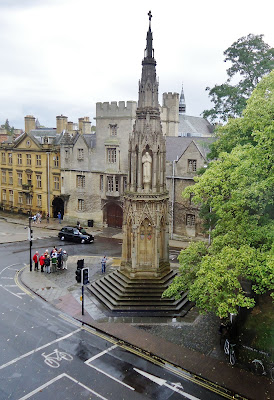
Martyrs' Memorial from the Randolph Hotel.
Balliol, and Back Entrance of Trinity, behind.
Oxford photos by JTMarlin, September 2012. |
America's bloody Civil War was fought over states' rights and slavery. Britain's Civil War (1642-51) was primarily about religion.
However, there is an interesting connection between the two civil wars. The religious wars in England in the 16th and 17th centuries continued to be played out in the American colonies and then the United States because:
- The settlers approved by the Crown were more likely to be in the southern colonies.
- The dissidents went to the northeast.
- The Revolution originated in the northeast and the southern states were convinced to join.
- After the United States was established, the differences among the two regions became more prominent.
A monument at the heart of Oxford is a reminder of how much Oxford and Cambridge were at the center of Britain's religious battles, and had an influence on the way the Revolution and Civil War played out in America.
The history takes us to Cambridge to Sidney Sussex College, Cambridge.
Catholic Persecution of Protestants, Oxford v. Cambridge
The east-facing view in Oxford from the Randolph Hotel's "Presidential Suite", where President Clinton once stayed, is of the Martyrs' Memorial. Behind it in grey stone is Balliol College, then the back entrance to Trinity College, and then St. John's.
The Memorial was erected to the memory of two Church of England archbishops and one bishop who were burned in 1555-56 at the behest of the ruling Catholic clergy - during the reign of Catholic Queen "Bloody" Mary I (1553-1558). Mary Tudor was the daughter of Henry VIII, who created the Church of England, and Roman Catholic Catherine of Aragon. Mary remained loyal to Roman Catholicism. She was preceded and succeeded by Protestants, Edward VI and Queen Elizabeth I.
 |
Martyrs' Memorial from the Randolph.
Detail of statue by Henry Weekes.
|
The three martyrs, ironically known as "Oxford Martyrs" although they were all Cambridge men, were Thomas Cranmer (Jesus College), Nicholas Ridley (Pembroke College) and Hugh Latimer (Clare College).
A friend from Cambridge, David River, told me there is a saying at Cambridge: "Cambridge makes martyrs. Oxford burns them."
Of the three martyrs, the Archbishop of Canterbury, Thomas Cranmer, was the most important, since he served as Henry VIII's adviser on obtaining an annulment of Henry's marriage to Catherine of Aragon and he was the architect of the Reformation.
 |
Martyrs' Memorial from
Ground. Balliol Behind. |
The martyrdoms of the Protestant bishops - whose offense was being unwilling to profess faith in the transubstantiation of the Eucharist - occurred in front of Balliol on Broad Street, and is marked by a cross in the middle of the street and a plaque on the Balliol wall nearby referring to it. The Memorial replaced a house, creating a space that allows this part of Oxford to include a bus stop and bicycle park.
The Protestant reign of Elizabeth I was benign after that of Mary. But during the reign of Charles I, dissident Protestants became restless about the privileges of the established church, and Parliament responded by building up its army, which was used by Oliver Cromwell to seize power.
The Civil War (1642-1651) - Cambridge Pilgrims vs. Oxford Orthodoxy
At Sidney Sussex College at Cambridge earlier this month, I visited the gravesite, since 1960, of Oliver Cromwell's head.
Oliver Cromwell was born in Huntington, near Cambridge, in 1599. He began his studies at Sidney Sussex on the day that Shakespeare died, April 23, 1616. Oliver's father died that year and Cromwell left the University after one year to support his family. He married and had many children.
He had a religious conversion to Puritanism in the 1630s, and rallied support from Protestants who dissented from the Church of England. The different sides of the Civil War were therefore complex, with the addition of Irish and Scottish nationalist concerns.
 |
Portrait of Oliver Cromwell (1599-
1658) hanging in Hall at Sidney
Sussex College, Cambridge.
Photo by JT Marlin, June 2014. |
Cromwell was elected to Parliament from Huntington in 1628 and then represented Cambridge in the Short Parliament of 1640 and the Long Parliament of 1640-49. In the meantime he advanced in the Parliamentary Army, from cavalry leader to a commander of the New Model Army created in 1645-46. He made Cambridge the military HQ of the Eastern Association of Counties. The country was divided into 11 military areas, each commanded by a major-general picked by Cromwell.
Cromwell almost single-handedly caused a break in the British monarchy. He led troops reporting to Parliament and tracked Charles I down in Oxford, defeating loyalist troops and putting Cromwell at the head of the government.
Although Cambridge was the center of the Roundheads and Oxford of the Cavaliers, many of the Cambridge colleges were pro-Royalist and gave much of their silver plate to help Charles I. Sidney Sussex sent £100 to help King Charles. When this later came to light, the Master of the College was put in prison.
After Charles was defeated, Cromwell urged Parliament to execute him, to reduce the likelihood of a rescue invasion by troops representing Roman Catholics from Ireland and the Continent. Cromwell was the third person on the list of those who signed the death warrant for the king. Charles I was beheaded in 1649. The Queen's website
suggests that Charles I was a martyr. On the other hand, future royals tended to be more respectful of Parliament. Charles I was the only monarch in British history to have been executed.
From 1649 to 1653, the Rump Parliament ran England under Cromwell's leadership. Cromwell properly feared a counter-attack from Catholics. Charles I's Queen was a Roman Catholic from France, Henrietta Maria, after whom Maryland is named. Charles II was in France to obtain the support of the Catholic monarch.
Cromwell's Irish Campaign, 1649-1650
Cromwell decided to address first a possible attack from the west, with Royalists in Ireland joining up with Irish Catholic confederates, and he decided to protect his back with a crushing campaign. Cromwell went to Ireland in August 1649 with an army of 6,000 troops to suppress an alliance that threatened to turn into a significant rebellion.
I spent my 10th year of life at Blackrock College in Dublin, Ireland, and one of my most vivid memories was hearing from the Holy Ghost Fathers how brutal Cromwell was to the Irish Catholics on this pre-emptive strike.
 |
Sign in a Cambridge restaurant. It
would be funnier if a Cambridge man
hadn't done just that to Irish children. |
Cromwell raised his large army by promising those who put up money for the expedition that their security would be Irish land. So from the beginning he intended to seize much Irish land and leave it in the hands of his supporters.
The Roundhead army met and overcame resistance in Drogheda, killed the garrison, and then moved on to Wexford, impatient to settle a score from 1641, when many Protestants drowned after defeat by the Catholic Confederates. The Wexford defenders were prepared to surrender and Cromwell sent a message suggesting he would be conciliatory. However, an estimated 2,000 defending soldiers and another 1,500 civilians were slaughtered, a massacre that Irish Catholics do not forget. Cromwell moved on to other Irish towns until Galway fell and the rebellion was declared ended in May 1650.
The aftermath of Cromwell's devastating march around Ireland was a
complete change in power. Penal Laws were instituted to keep the population from organizing any resistance. Cromwell's armed agents rounded up Irish beggars, widows and orphans to be sold as slaves or indentured servants to the sugar plantations of the West Indies. The reprisals were directed not only at Roman Catholics but at Ulster Presbyterians, Church of Ireland members and other minority religions. Priests were hanged, exiled or transported to the West Indies. Puritan preachers were brought over from England to replace them.
Cromwell's Scottish Campaign, Victory over Charles II and His Regime
After leaving Ireland, Cromwell's troops moved on to a 1650-1651 campaign in Scotland, with similarly ruthless treatment of Royalists and other potential rebels. The much-feared invasion from France did occur in 1651, but Cromwell by now had a large, seasoned and trained army ready for the invasion. He prevailed at the Battle of Worcester, bringing the Civil War formally to a close.
From 1653 until his death in 1658, Cromwell dissolved Parliament and ruled as Lord Protector as long as he lived. However, even the English came to dislike living under Cromwell's Puritanical regime. His religious conversion in the 1930s led him to dissent from the Church of England, on the basis that the official church had departed from strict adherence to the Ten Commandments and other rules gleaned from the Bible. The Puritans believed that enjoying too many pleasures meant yielding to the Devil and would lead to damnation.
Cromwell essentially ran a Christian caliphate. He shut down many drinking places and sports events. Swearing was punished by a fine, even imprisonment. On Sundays, work was banned and even going for a walk, if not to an approved church, could lead to a fine. Feast days were replaced by a monthly fast day.
Cromwell banned feasting or caroling at Christmas, insisting it be celebrated only as a religious event; for example, in London, soldiers confiscated food being cooked for a Christmas dinner and Christmas decorations were banned.
(Later, the Oxford Movement resurrected Christmas carols and Oxford's Charles Wesley wrote "Hark the Herald Angels Sing" and with his brother earned points for Methodism by championing the revival of caroling. The most popular early carol in America was "Joy to the World", written by English hymn-writer Isaac Watts based on Psalm 98.)
Women were forbidden by the Puritans from wearing makeup or overly colorful dresses. They were required to wear a long black dress that covered them to their shoes, with a white apron and headdress. Puritan men wore black clothes and short hair. However, Cromwell himself enjoyed hunting, music and games and allowed ample entertainment at his daughter’s wedding.
Cromwell died in September 1658. His coffin was escorted by more than 30,000 soldiers to Westminster Abbey to be buried. His son, Richard Cromwell, took over as the Second Lord Protector in 1658 but lasted only nine months. The nickname the Royalists gave him was "Queen Dick". In 1659 he quit (or perhaps more likely was encouraged by the army to leave) and exiled himself overseas.
The Restoration of Charles II and the Saga of Cromwell's Head
 |
A 1960 plaque noting that Cromwell's head is buried nearby in
Sidney Sussex College. |
Charles II was invited to return from exile to become king of England. His return was enthusiastically welcomed by a nation tired of the religious wars.
After the Restoration of the monarchy, Charles II ordered Cromwell’s body, along with two co-conspirators, to be dug up and put on "trial" as traitors and regicides. Cromwell's body and those of his colleagues were found guilty and were hanged from the gallows at Tyburn. Cromwell's head was put on display on a 20-foot pike over Westminster Hall until in 1685 wind from a storm outside broke the pike. Cromwell's head was in private hands from 1685 until 1960.
In 1960, Cromwell's head was given to Sidney Sussex, and it was buried there secretly in an undisclosed location somewhere in the ante-chapel of the College. The strange story is told authoritatively on the
Westminster Abbey and
Sidney Sussex websites.


