Showing posts with label College of Arms. Show all posts

Sunday, January 21, 2018

U.S. COATS OF ARMS | American College of Heraldry

Full achievement of coat of arms of the
American College of Heraldry.
January 21, 2018 – The American College of Heraldry was organized as a nonprofit in 1972 in New Orleans, Louisiana. It was incorporated as a nonprofit and operates on a charter from the State of Alabama.

The primary contact for the American College of Heraldry is currently in Little Rock, Arkansas.

It provides services to assist American citizens in the design and registration of wholly new armorial bearings, since there is no U.S. Government agency providing such a service. 

The American College of Heraldry works with individuals in designing heraldically correct achievements of arms and issues registrations of such arms, and publishes details of these registrations in its quarterly magazine, The Armiger's News.  The College will also consider application for registration of arms by non-U.S. citizens who have already been granted armorial bearings from an active armorial authority such as the College of Arms in London or the Court of Lord Lyon in Edinburgh. 

The College charges $325 to Americans for assisting in designing and registering a new coat of arms. The charge is slightly higher for non-Americans.

A listing of international groups that grant or register arms is provided by Araltas, which recommends South African heraldry services as free or inexpensive.

The American College of Heraldry should not be confused with a previously established group, The American College of Heraldry and Arms, Inc., which was founded in 1966 and closed down in 1970. It allegedly rejecting one thousand applications for arms, but no records of them have been identified as of the date of this post.

Sunday, November 5, 2017

COLLEGE OF ARMS, LONDON | 2017 Fees

The 2017 College of Arms fee schedule for a coat of arms and crest is shown below. 

"Impersonal" arms would be for a city or town or church. The arms without crest would be the shield.

 The crest is above the shield and typically adorns a helmet. In the North Warwickshire Borough Council coat of arms the crest is a lion rampant holding a cross fleury.

A "badge" is an armiger's equivalent to a logo. It would appear on clothing worn by staff, for example. It is interesting that the badge is priced only for commercial companies. 

Any graduate of a good college with no identifiable character blemishes and a connection to England or Wales (as would be the case for any graduate of an English University) can petition to the Queen for a coat of arms. 

Wednesday, December 16, 2015

HERALDRY: St Catherine's (Updated May 14, 2018)

Arms of St Catherine's
College, Oxford.

Blazon: Sable a Saltire Ermine between four Catherine Wheels Or.  

Authority: The arms, according to St Catz officials, were granted by the College of Arms in 1964, two years after St Catz opened. The Letter Patent, usually signed and sealed by all the three Kings of Arms on behalf of the College of Arms, is reportedly in a secure location at St Catz. A printed source (below left) confirms the granting of arms for St Catz, with the date of the grant June 10, 1963, which could mean that there was a six-month delay from the internal grant to the preparation and signing of the Letter Patent.

This source confirms the St Catherine's Grant as of 1963.
Full Achievement: Below the shield is a motto: Nova et Vetera – "The new and the old." The grant of arms normally shows the full achievement with a crest as well and a mantle. This would be to the left of the Blazon on the grant.

Meaning: The name of the college and the "Catherine wheels" in the four fields created by the ermine saltire refer to St Catherine of Alexandria, Egypt, then a great center of learning. A saltire is associated with martyrdom. St Catherine's badge is a wheel.

Nominee of Arms: A virgin martyr, St Catherine was the daughter of non-believing parents but became a Christian at 18. She is one of the two saints that Joan of Arc a millennium later said talked with her. Emperor Maxentius (ruled 306-312) wanted her to marry one of his sons if she would give up her Christian beliefs. He brought her to Rome, but she publicly protested to the emperor against worshipping of idols. Confronted by 50 philosophers, she refuted them and they were burned alive for being unable to rebut her arguments. She refused to deny her faith and marry the emperor, who then had her beaten for two hours on end and imprisoned. Continuing to refuse Maxentius' proposals, she was sentenced to be broken on a spiked wheel. However, it fell to pieces at her touch. Maxentius had her beheaded instead. Maxentius was defeated by Constantine in 312. Catherine is today a revered Catholic and especially Eastern Orthodox saint, whose feast day is November 25 (24 in some Eastern Orthodox churches). A few crusty historians question whether she existed or was the product of centuries-later legend-creators. She is nonetheless embraced as their patron saint by female students, young women in the workplace, nuns, philosophers, preachers and, naturally, wheelwrights.

Similar Arms: St Hugh's also has a sable field with a saltire ermine. Where St Catz has a Catherine wheel or, St Hugh's has a fleur-de-lys or.

Institutional History: The College was originally formed as the Delegacy of Non-Collegiate Students, founded in 1868 to offer a university education without the costs of college membership. The social role of a college was created by the Delegacy's students, who met in a meeting room in a hall on Catte Street under the unofficial name of St Catherine's Club. The Club was officially recognized by the University in 1931 as St Catherine's Society. In 1956 the University Delegates formalized the change, offering the Society a path to college status. By 1960 Sir Alan Bullock matched some University funding with £1 million from Sir Alan Wilson and Sir Hugh Beaver. Having raised a total of £2.5 million, the college opened in 1962, while still under construction, as a men's college. It was the year that I came up to Oxford and I remember the tentative nature of the opening. By 1974 St Catz was in full operation and was one of the first five men's colleges to admit women as full members, the other four being Brasenose, Hertford, Jesus and Wadham.

St Catz Boat Club: The Catz Boats are housed in the Long Bridges Boat House. The blades of the college oars are decorated with Catherine Wheels. On the excellent Catz Boat Club website, the Boat Club historian Don Barton reports that six years after the University established a society for non-Collegiate students in 1868, members founded St Catharine’s Club, using the incorrect Cambridge spelling of the word. The following year, St Catharine’s Boat Club was created. The spelling was corrected to St Catherine's in 1919. At this time the society was given the name of the Boat Club. The Boat Club thus gave the name to both the original society and the College that it grew into. The Boat Club first took part in Torpids and Summer Eights in 1876, and produced the first crew to make seven bumps in the then six days of Summer Eights. Three crews made six bumps in Eights in 1949). The Women’s 1st Eight won Head of the River in Torpids in 2007. St Catz achieved its first Blue in 1967 and first women's Blues in 1976. International representation of St Catz began with the Commonwealth Games in 1958; since 1986 men and women rowers from the Boat Club have regularly filled places in national crews. Matthew Pinsent was the first St Catz Olympic Gold in 1992.

Physical History: Once offered the opportunity for college status, St Catz staked out and purchased from Merton College eight acres on part of Holywell Great Meadow, on the eastern side of Oxford looking over the Cherwell. Its glass-and-concrete buildings by the Danish architect Arne Jacobsen in 1993 received a Grade I listing as a "Building of Special Architectural or Historic Interest". The buildings combined modern construction materials with the traditional quadrangle layout, and the architect has followed through on his design to the furniture, lampshades and cutlery. The dining hall is distinctive for its Cumberland slate floor and its 350 seats, the largest capacity of any Oxford college. Jacobsen's plans for the college did not include a chapel; the college's December Christmas carol concert is held in Harris Manchester College's chapel. However, the college does have a prominent bell tower, rising above the other college structures, which top out at three stories because of a concern that the foundations are dug into marshland. St Catz has lecture theatres and seminar rooms, spacious common rooms, a music house, two student computer rooms, a small gym, squash courts and a punt house on the Cherwell.

Sources: St Catz: Web siteMaxentius: "A Topography of Death: The Buildings of the Emperor Maxentius on the Via Appia, Rome," in M. Carruthers et al. (eds) Eleventh Annual Proceedings of the Theoretical Roman Archaeology Conference, 24-33, Oxford: Oxbow. St Catherine: Encyclopedia Britannica. Mateus Soares de Azevedo, Ye Shall Know the Truth: Christianity and the Perennial Philosophy, World Wisdom, 324.  Harold Thayer Davis, Alexandria: The Golden City, Principia Press of Illinois, 1957, 441.  Donald Attwater and Catherine Rachel John, The Penguin Dictionary of Saints, 3rd ed, London: Penguin, 1995, p. 77.

Other Posts on the Arms of Oxford Colleges and PPHs: Original Article in Oxford Today . Heraldry as Branding . Heraldry as Fun .  Coat of Arms vs. Crest . Sinister Questions . Visit to the College of Arms . Windsor Herald Talks to New Yorkers . Shaming of Harvard Law Shield :: Rapid Expansion of Oxford's Colleges and Halls . Oxford Stars . HERALDRY SUPERLINK . Harris Manchester College . Linacre College . St Catherine's . St Cross College . St Edmund Hall . Trinity College :: Regent's Park College . St Benet's Hall . 

Monday, November 23, 2015

HERALDRY: Simple and Fun

The Earl Marshal (Duke of Norfolk) is the English
authority on arms, and his Court at the College
of Arms decides disputes. In Scotland, it is Lord
Lyon King of Arms. [All illustrations from the
1953 book, Simple Heraldry].
As a relative newcomer to the heraldry field, bitten by the bug less than ten years ago, earlier this year (in February and September) I was haunting heraldry collections in Oxford and London, such as:
  • the Bodleian's newly reopened Weston Library with small open-stack collection of useful books, 
  • the British Library's huge collection, easily accessible, 
  • the College of Arms library, which sadly in February I could not consult because it was being renovated, and 
  • the Society of Genealogists, which I have joined; it has a decent collection and is well-staffed with paid and unpaid experts on hand.
The genealogy and local history room at the New York Public Library is disappointing because the stacks that are open are strong on local history but not on heraldry.

The book that best fits my attitude toward heraldry – that it is loads of fun, Tolkien on steroids – is Simple Heraldry Cheerfully Illustrated, by Iain Moncreiffe (Falkland Poursuivant) and Don Pottinger (Herald Painter Extraordinary to the Court of Lord Lyon). My first copy was given to me by Paul Walton (Brasenose College, Oxford). I have since acquired a second copy online.

The book takes a light-hearted approach to its subject while it gets everything, so far as my amateur scan can determine, right. In other words, the style is like 1066 and All That, but the content is non-fiction.

Simple Heraldry is not a book of recent vintage. In fact it is 62 years old – if it were an American citizen, the book could get in line for a national pension, although the penalties for early withdrawal suggest that the book should wait a little longer before applying for its monthly direct deposit.

The publisher is Edinburgh-based Thomas Nelson and Sons, founded 1798 and now a subsidiary of HarperCollins. The last edition on record is 1955, being a reprint of the original edition.
Note the Moray or Murray arms – three stars argent on
a field azure. The main difference with the Douglas
arms is that for Douglas the azure is in chief only
and the stars are three in a row.
Its age shows up on p. 62, where it reports that
you may apply to the Earl Marshal through the College of Arms for Letters Patent granting you special arms of your own. This costs £105...
In February, Windsor Herald told me that the cost for an individual was now £5,500. The cost is higher for institutions like nonprofits and local governments. It is highest for large businesses.

What Blazon are You? What a
blazon is, from Simple Heraldry.
Two copies of the book were available second hand online via Amazon for $35 each – a bargain.

I purchased one of them instantly. So there is one left. The book is underpriced.

Comment

This is just the kind of self-mocking book to rekindle more interest in heraldry. It should be updated and reissued. If someone knows what the status of the rights is, please contact me at john[at]boissevainbooks.com.

Friday, October 23, 2015

HERALDRY: Coat of Arms vs. Crest

All of the above add up to an "Achievement"
 of the owner's coat of arms.
Ian Senior (Trinity 1958) sends out an independent Trinity College alumni newsletter from time to time. It supplements the good work of the College's alumni relations and development team.

In Senior's previous issue he kindly mentioned my article on the Coats of Arms of the Oxford Colleges. In his article, seeking to sustain his readers' interest by varying his language, he uses the word crest as a synonym for a coat of arms.

This rouses Robert Parker (Trinity 1967) to write to Senior making clear that a crest is not a coat of arms. He says:
I too read John Tepper Marlin’s (Trinity 1962) article in Oxford Today with great interest, but the article is about “Coats of Arms”, not “Crests”! A Crest is a quite separate device, used for identifying one’s property, or as a badge (e.g., the Trinity double-headed Gryphon device on the Trinity College Boat Club tie), while the “Achievement of Arms” of the modern colleges, with which the article is concerned, are all full “Coats of Arms” - i.e., a shield, emblazoned.
Arms granted by the College of
Arms to the widow of a lawyer who
represented "ladies of the night".
Senior responds: "Glad to be put right on coats of arms, or could I also call them escutcheons? - Ed."

The answer to Senior's question is in the figure above. A coat of arms may include an escutcheon or shield (which seem to be synonyms). But it often includes other elements of the Achievement. When you, as an individual, go to the College of Arms and pay the $8,000 fee (upon approval of your application), you should expect to get The Works - a full Achievement with crest, motto and whatever else fits, plus the seal of one or more of the Kings of Arms, certifying that you have been granted the arms.

Windsor Herald demonstrated this at a talk earlier this week in New York City. He designed a coat of arms for a deceased attorney whose widow wanted to obtain for him a posthumous coat of arms. The bread and butter of the distinguished attorney's business was the defense of what Windsor Herald described delicately as "ladies of the night".

So we see on the shield at right a cut-off view, in two rows, of Six Ladies Dancing. The black (sable) vertical bars evoke the view from a prison cell.

The widow was pleased with this memory of her late spouse, which I have no doubt was easy for some Poursuivant to establish as unique.

From what I understand, while many people who apply are refused arms, Oxford alumni who have managed to stay out of jail – and maybe some who have done time in a good cause – can make a pretty good case for their being entitled to bear arms, in the heraldic sense, with the endorsement of the College of Arms.

Since I have a sentimental interest in the continuation of the institution, I encourage anyone who reads this and has a spare $8K that is getting laughably little interest from a bank to apply for a coat of arms. Cheaper than a Monet.

Comments: Coat of Arms vs. Crest Harris Manchester  Linacre

Tuesday, October 20, 2015

HERALDRY: Windsor Herald Speaks in NYC

Windsor Herald speaks at the New York Genea-
logical and Biographical Society at 36 W 44 St.
A few hours ago I went to the New York Genealogical and Biographical Society to hear Windsor Herald, William Hunt.

We met earlier this year in London when I was doing research for my article on the coats of arms of the Oxford Colleges, which has just been published in Oxford Today.

He started with some background about the College of Arms, of which he is an officer. The heralds carry the rank either of King of Arms or Herald. The Heralds work on the design and blazon of the arms to ensure that they are unique, assisted by Poursuivants, and the Kings of Arms grant the arms under the authority of the Crown.

Coats of arms in England date back to circa 1128 when the arms of Geoffrey, Count of Anjou were said to be established. He started the Plantagenet (his nickname) royal line. A picture of his shield on his tomb shows what appears to be a forerunner of today's royal coat of arms. But the descriptions of his arms are not contemporary, and no one is certain which arms in England are the oldest.

The College of Arms in London is next to St. Paul's Cathedral. The 1666 Great Fire of London - which left one-sixth of the population homeless - destroyed the original building. The College of Arms building that we see today is the one built after the Great Fire, minus one of the four sides.
The fourth side was removed, says Windsor Herald, to make room for Queen Victoria Street, which the College now faces.

Windsor Herald showed several of the pedigrees that are stored at the College of Arms. Some of them show dubious links stretching from Adam and Eve without interruption to and some early English kings. The pedigrees are often propaganda instruments - for example, by placing key individuals on one or other side of the Wars of the Roses.

During the time of Henry VIII the wish for coats of arms spread and the Crown decided it would be a good source of revenue to tax people who have them.

Windsor Herald provided a series of examples of
coats of arms that he has designed. This one is
especially funny, paid for by the widow of a lawyer
who defended "ladies of the night".
Windsor Herald said that virtually anyone who has lived in England for several generations, if they are resourceful enough can trace their ancestry back to one or other king.

He showed how quartering of arms works. When a man entitled to a coat of arms marries a woman who also bears arms (e.g., by having no children, or by being widowed), the arms are "quartered". He showed examples of quartering ad absurdum.

Someone who wants a coat of arms applies to the Earl Marshal. The Court of the Earl Marshal is the only room at the College of Arms that is open to the public.

The arms are "granted" by one or more of the three Kings of Arms, for a fee (about $8,000 for an individual coat of arms, more for institutional arms), which pays mostly for the overhead of the College of Arms along with the design or certification work by Heralds and their Poursuivants.

Windsor Herald then went through a series of examples of interesting coats of arms. The right to bear arms has to be established either by genealogy, showing descent from an ancestor who bore arms, or de novo by community recognition, including professional qualification or a university degree. The acceptable qualifications are fairly broad, but Windsor Herald says that the College of Arms frequently turns down applicants for coats of arms.

Comment

The College of Arms is a bit like a bank. Banks don't like to lend money to people who really need it. (The banks are worried about being paid back.) If a person really needs a coat of arms, one has to ask why? The question is easier to answer for institutions, which have always needed a corporate identity.


Saturday, August 15, 2015

HERALDRY: The College of Arms and Windsor Herald

Nigel Armstrong-Flemming.
All photos by JT Marlin.
On February 7 this year, at the Pitt Dinner at Trinity College, Oxford, I met Nigel Armstrong-Flemming.

A few weeks later he kindly introduced me to Windsor Herald, an officer of arms at the College of Arms, also known as the College of Heralds.

The office of Windsor Herald is older than the College of Arms itself. It was reportedly created by Edward III in 1364 when a Pursuivant of Edward brought him news of the British victory at Auray. He was rewarded by promotion to Herald with the title Windsor.
------------------
Celebratory Note: My article in Oxford Today on the Oxford colleges' coats of arms may be found here.
-------------------

In 1419, Windsor Herald was sent to the Duke of Brittany and has been maintained since then. The badge of office is the sunburst badge of Edward III royally crowned.

William George Hunt, Windsor Herald, out of uniform,
at the Armoury House in London. Photo by JT Marlin.
Best-known of Windsor Heralds is surely 17th century antiquarian Elias Ashmole, a Brasenose College, Oxford graduate.

Ashmole gave his extensive library to Oxford, which in return put his name on its museum, now the Ashmolean Museum (newly renovated and not to be missed, opposite the Randolph).

Windsor Herald today is William George Hunt, TD, BA (Southampton), FCA. We met at lunch at the historic Armoury House in London.

He then gave me a tour of the College of Arms, abbreviated by the fact that the library area is being renovated.

The College corporation is overseen by the Earl Marshal, a hereditary office held by the Duke of Norfolk, currently Edward Fitzalan-Howard, 18th Duke of Norfolk. The College is composed of 13 officers or heralds:
  • Three Kings of Arms (Garter, Clarenceux and Norroy & Ulster).
  • Six Heralds (Chester, Lancaster, Richmond, Somerset, Windsor and York).
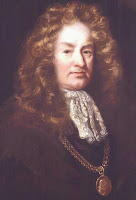
  • Elias Ashmole, by
    John Riley.
  • Four Pursuivants (Bluemantle, Portcullis, Rouge Croix and Rouge Dragon). 
The office of Garter was created in 1415 by Henry V.  Garter Principal King of Arms is Thomas Woodcock, CVO, since April 1, 2010; he succeeded Sir Peter Gwynn-Jones, KCVO.

In addition to these officers, seven officers extraordinary take part in ceremonial occasions but are not part of the College.

College of Arms, London. Photo by JT Marlin.
The College of Arms, a royal corporation that is empowered, among other things,  to give a "grant of arms". Without such a grant, no one can be sure that their coat of arms is unique or will not be copied with impunity. A coat of arms without a grant is called an "unofficial" or "hypothetical" coat of arms.

Windsor Herald in the Library, being renovated, of the
College of Arms.
Heralds may design coats of arms, but only the three Kings of Arms may grant them in England, Wales, Northern Ireland and some Commonwealth countries.

The grant of arms certifies that the coat of arms is original and the College of Arms is ready to help stop someone else from using it, e.g., in a civil suit.

Before a grant is made, it is preceded by painstaking research to ensure that no one else has previously used such a coat of arms.

Scotland has its own independent heraldic authority, the Court of the Lord Lyon. Use of arms in Scotland is governed by criminal law and, for example, marks of cadency (for younger sons) must be used to insure that each coat of arms is unique to an individual.

Windsor Herald and other heralds have a skilled staff including the Poursuivants (apprentice heralds) and historic resources, including categorizations by type of "device" on huge numbers of coats of arms. The College of Arms is unusually well equipped to research a coat of arms before providing a design or a grant of arms.

It is a challenge to maintain these resources. The officers are appointed by the British Crown, which delegates authority to act on the Queen's behalf in all matters of
  • heraldry and the granting of new coats of arms, 
  • genealogical research and the recording of pedigrees, and
  • Note that all three Kings of Arms have signed this
    grant of arms, as is customary.
  • vexillogical questions, i.e.,  issues relating to the flying of flags on land and maintaining official registers of flags and other national symbols.
The College of Arms also consults on the planning of many ceremonial occasions such as coronations, state funerals, the annual Garter Service and the State Opening of Parliament.

Heralds of the College accompany the sovereign on many of these occasions.

Though a part of the Royal Household of the United Kingdom, the College is self-financed, not supported by the British taxpayer. If you are thinking of adopting a coat of arms for family or institution, I urge you to go through channels and get a grant of arms. The grant fees, listed on the website of the College of Arms, are lowest, about $9,000 for an individual. The fee is higher for nonprofit institutions and is most expensive for profit-making corporations.

Founded 531 years ago (in 1484) by a royal charter from Richard III, the College is one of the few remaining official heraldic authorities in Europe. It has been located in the City of London since its foundation, and has been at its present address on Queen Victoria Street for 460 years (since 1555), which must be some kind of record.

Americans can contribute to support of the College of Arms through a Foundation administered by the New York Genealogical and Biographical Society. The foundation web site reports that it is registered as a 501(c)(3) corporation. I have made a modest gift to the foundation. To do the same, you can send dollar contribution checks, which are deductible from taxable income reportable to the IRS, to the Treasurer of the Foundation:

Robert W. Thompson, Treasurer
College of Arms Foundation, Inc.
58 Seneca Place
Oceanport, NJ 07757