Showing posts with label Windsor Herald. Show all posts

Friday, October 23, 2015

HERALDRY: Coat of Arms vs. Crest

All of the above add up to an "Achievement"
 of the owner's coat of arms.
Ian Senior (Trinity 1958) sends out an independent Trinity College alumni newsletter from time to time. It supplements the good work of the College's alumni relations and development team.

In Senior's previous issue he kindly mentioned my article on the Coats of Arms of the Oxford Colleges. In his article, seeking to sustain his readers' interest by varying his language, he uses the word crest as a synonym for a coat of arms.

This rouses Robert Parker (Trinity 1967) to write to Senior making clear that a crest is not a coat of arms. He says:
I too read John Tepper Marlin’s (Trinity 1962) article in Oxford Today with great interest, but the article is about “Coats of Arms”, not “Crests”! A Crest is a quite separate device, used for identifying one’s property, or as a badge (e.g., the Trinity double-headed Gryphon device on the Trinity College Boat Club tie), while the “Achievement of Arms” of the modern colleges, with which the article is concerned, are all full “Coats of Arms” - i.e., a shield, emblazoned.
Arms granted by the College of
Arms to the widow of a lawyer who
represented "ladies of the night".
Senior responds: "Glad to be put right on coats of arms, or could I also call them escutcheons? - Ed."

The answer to Senior's question is in the figure above. A coat of arms may include an escutcheon or shield (which seem to be synonyms). But it often includes other elements of the Achievement. When you, as an individual, go to the College of Arms and pay the $8,000 fee (upon approval of your application), you should expect to get The Works - a full Achievement with crest, motto and whatever else fits, plus the seal of one or more of the Kings of Arms, certifying that you have been granted the arms.

Windsor Herald demonstrated this at a talk earlier this week in New York City. He designed a coat of arms for a deceased attorney whose widow wanted to obtain for him a posthumous coat of arms. The bread and butter of the distinguished attorney's business was the defense of what Windsor Herald described delicately as "ladies of the night".

So we see on the shield at right a cut-off view, in two rows, of Six Ladies Dancing. The black (sable) vertical bars evoke the view from a prison cell.

The widow was pleased with this memory of her late spouse, which I have no doubt was easy for some Poursuivant to establish as unique.

From what I understand, while many people who apply are refused arms, Oxford alumni who have managed to stay out of jail – and maybe some who have done time in a good cause – can make a pretty good case for their being entitled to bear arms, in the heraldic sense, with the endorsement of the College of Arms.

Since I have a sentimental interest in the continuation of the institution, I encourage anyone who reads this and has a spare $8K that is getting laughably little interest from a bank to apply for a coat of arms. Cheaper than a Monet.

Comments: Coat of Arms vs. Crest Harris Manchester  Linacre

Tuesday, October 20, 2015

HERALDRY: Windsor Herald Speaks in NYC

Windsor Herald speaks at the New York Genea-
logical and Biographical Society at 36 W 44 St.
A few hours ago I went to the New York Genealogical and Biographical Society to hear Windsor Herald, William Hunt.

We met earlier this year in London when I was doing research for my article on the coats of arms of the Oxford Colleges, which has just been published in Oxford Today.

He started with some background about the College of Arms, of which he is an officer. The heralds carry the rank either of King of Arms or Herald. The Heralds work on the design and blazon of the arms to ensure that they are unique, assisted by Poursuivants, and the Kings of Arms grant the arms under the authority of the Crown.

Coats of arms in England date back to circa 1128 when the arms of Geoffrey, Count of Anjou were said to be established. He started the Plantagenet (his nickname) royal line. A picture of his shield on his tomb shows what appears to be a forerunner of today's royal coat of arms. But the descriptions of his arms are not contemporary, and no one is certain which arms in England are the oldest.

The College of Arms in London is next to St. Paul's Cathedral. The 1666 Great Fire of London - which left one-sixth of the population homeless - destroyed the original building. The College of Arms building that we see today is the one built after the Great Fire, minus one of the four sides.
The fourth side was removed, says Windsor Herald, to make room for Queen Victoria Street, which the College now faces.

Windsor Herald showed several of the pedigrees that are stored at the College of Arms. Some of them show dubious links stretching from Adam and Eve without interruption to and some early English kings. The pedigrees are often propaganda instruments - for example, by placing key individuals on one or other side of the Wars of the Roses.

During the time of Henry VIII the wish for coats of arms spread and the Crown decided it would be a good source of revenue to tax people who have them.

Windsor Herald provided a series of examples of
coats of arms that he has designed. This one is
especially funny, paid for by the widow of a lawyer
who defended "ladies of the night".
Windsor Herald said that virtually anyone who has lived in England for several generations, if they are resourceful enough can trace their ancestry back to one or other king.

He showed how quartering of arms works. When a man entitled to a coat of arms marries a woman who also bears arms (e.g., by having no children, or by being widowed), the arms are "quartered". He showed examples of quartering ad absurdum.

Someone who wants a coat of arms applies to the Earl Marshal. The Court of the Earl Marshal is the only room at the College of Arms that is open to the public.

The arms are "granted" by one or more of the three Kings of Arms, for a fee (about $8,000 for an individual coat of arms, more for institutional arms), which pays mostly for the overhead of the College of Arms along with the design or certification work by Heralds and their Poursuivants.

Windsor Herald then went through a series of examples of interesting coats of arms. The right to bear arms has to be established either by genealogy, showing descent from an ancestor who bore arms, or de novo by community recognition, including professional qualification or a university degree. The acceptable qualifications are fairly broad, but Windsor Herald says that the College of Arms frequently turns down applicants for coats of arms.

Comment

The College of Arms is a bit like a bank. Banks don't like to lend money to people who really need it. (The banks are worried about being paid back.) If a person really needs a coat of arms, one has to ask why? The question is easier to answer for institutions, which have always needed a corporate identity.


Thursday, October 15, 2015

HERALDRY: "What's Your Blazon?" in "Oxford Today" (Updated Mar 8, 2017)

Cover of The Michaelmas 2015 Oxford Today.
Sent to a quarter-million Oxonians: The Michaelmas 2015 issue of Oxford Today.

On p. 66, note the fine obit of Dan Topolski, about whose life and death I have posted.

My article, "What's Your Blazon?" is on pages 45-50. I am grateful to Ian Senior, who emails out a  newsletter about Oxford, for alerting his readers to what he calls a "very interesting" article.

Special thanks to Windsor Herald, William George Hunt, TD, BA (Southampton, UK), FCA, for giving me a tour of the College of Arms in London when I visited in February. I add more acknowledgments at the end of this post.

The College of Arms is, especially for an American, an amazing institution. The traditions go back to Edward III and 1364, 651 years ago. It is the ancient predecessor of something most Americans think they invented – brands and trademarks.

To show my gratitude to the College of Arms for keeping alive the heraldic traditions, I made a contribution to their U.S. foundation and I urge other Americans to do the same. The College has managed to survive for six-and-a-half centuries, mostly from fees and contributions from private sources. But in inflation-adjusted money its revenues have not been keeping pace. Americans can make gifts deductible from taxable income to support the College of Arms through the College of Arms Foundation, administered by the New York Genealogical and Biographical Society.

The rich topic of the Oxford and Cambridge college coats of arms is ripe for greater enjoyment. Heraldry is too much fun to be restricted to specialists, although I am determined to keep learning as much as I can. We don't want to go to the other extreme either, of the mass-produced "family" coats of arms.

Anyone with greater expertise or imagination, please share comments with me here and I promise to email back my appreciation for any feedback, any further required contrition and of course I will correct anything I have posted online that needs to be corrected.

Last month I spent a day at the Society of Genealogists (SOG) in London (they have an excellent heraldry section in their library) and I have become a member.

On Monday in New York City I will be going to the next heraldry committee meeting of the New York Genealogical and Biographical Society (NYGBS), which I have joined and where Windsor Herald will be speaking.

Exonerating anyone else from any shortcomings as a heraldry expert, I would like to acknowledge the help of a number of sources, for which there is little space in Oxford Today articles. The heraldry holdings of the British Library and New York Public Library were helpful (although I wish more of the NYPL holdings were open-stack, as they are at the British Library), as well as genealogical societies in New York (NYGBS) and London (SOG). The library at the College of Arms was under reconstruction when I visited, so I wasn't able to use it much. The new Weston Library of the Bodleian in Oxford has a small but helpful open-stack collection.

Several people read drafts of my article. My wife Alice Tepper Marlin, of course, read it at an important juncture. Marlene Rehkamp, with whom I worked in the New York City Comptroller's Office, kindly gave it a thorough read and as usual came up with excellent suggestions.  The Editor of Oxford Today, Richard Lofthouse, saw the potential for the article at an early stage and deserves huge credit for turning Oxford Today into a forum for general discussion among alumni around the world, both in print and online. I think we are increasingly finding out that print and cyberspace have a lot to offer each other.

Other Posts on the Arms of Oxford Colleges and PPHs: Original Article in Oxford Today . Heraldry as Branding . Heraldry as Fun .  Coat of Arms vs. Crest . Sinister Questions . Visit to the College of Arms . Windsor Herald Talks to New Yorkers . Shaming of Harvard Law Crest :: Rapid Expansion of Oxford's Colleges and Halls . Oxford Stars . Links to Heraldry, Oxford, GW . Harris Manchester College . Linacre College . St Catherine's . St Cross College . St Edmund Hall . Trinity College :: Regent's Park College . St Benet's Hall . 

Saturday, August 15, 2015

HERALDRY: The College of Arms and Windsor Herald

Nigel Armstrong-Flemming.
All photos by JT Marlin.
On February 7 this year, at the Pitt Dinner at Trinity College, Oxford, I met Nigel Armstrong-Flemming.

A few weeks later he kindly introduced me to Windsor Herald, an officer of arms at the College of Arms, also known as the College of Heralds.

The office of Windsor Herald is older than the College of Arms itself. It was reportedly created by Edward III in 1364 when a Pursuivant of Edward brought him news of the British victory at Auray. He was rewarded by promotion to Herald with the title Windsor.
------------------
Celebratory Note: My article in Oxford Today on the Oxford colleges' coats of arms may be found here.
-------------------

In 1419, Windsor Herald was sent to the Duke of Brittany and has been maintained since then. The badge of office is the sunburst badge of Edward III royally crowned.

William George Hunt, Windsor Herald, out of uniform,
at the Armoury House in London. Photo by JT Marlin.
Best-known of Windsor Heralds is surely 17th century antiquarian Elias Ashmole, a Brasenose College, Oxford graduate.

Ashmole gave his extensive library to Oxford, which in return put his name on its museum, now the Ashmolean Museum (newly renovated and not to be missed, opposite the Randolph).

Windsor Herald today is William George Hunt, TD, BA (Southampton), FCA. We met at lunch at the historic Armoury House in London.

He then gave me a tour of the College of Arms, abbreviated by the fact that the library area is being renovated.

The College corporation is overseen by the Earl Marshal, a hereditary office held by the Duke of Norfolk, currently Edward Fitzalan-Howard, 18th Duke of Norfolk. The College is composed of 13 officers or heralds:
  • Three Kings of Arms (Garter, Clarenceux and Norroy & Ulster).
  • Six Heralds (Chester, Lancaster, Richmond, Somerset, Windsor and York).
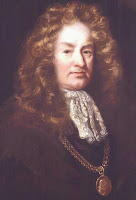
  • Elias Ashmole, by
    John Riley.
  • Four Pursuivants (Bluemantle, Portcullis, Rouge Croix and Rouge Dragon). 
The office of Garter was created in 1415 by Henry V.  Garter Principal King of Arms is Thomas Woodcock, CVO, since April 1, 2010; he succeeded Sir Peter Gwynn-Jones, KCVO.

In addition to these officers, seven officers extraordinary take part in ceremonial occasions but are not part of the College.

College of Arms, London. Photo by JT Marlin.
The College of Arms, a royal corporation that is empowered, among other things,  to give a "grant of arms". Without such a grant, no one can be sure that their coat of arms is unique or will not be copied with impunity. A coat of arms without a grant is called an "unofficial" or "hypothetical" coat of arms.

Windsor Herald in the Library, being renovated, of the
College of Arms.
Heralds may design coats of arms, but only the three Kings of Arms may grant them in England, Wales, Northern Ireland and some Commonwealth countries.

The grant of arms certifies that the coat of arms is original and the College of Arms is ready to help stop someone else from using it, e.g., in a civil suit.

Before a grant is made, it is preceded by painstaking research to ensure that no one else has previously used such a coat of arms.

Scotland has its own independent heraldic authority, the Court of the Lord Lyon. Use of arms in Scotland is governed by criminal law and, for example, marks of cadency (for younger sons) must be used to insure that each coat of arms is unique to an individual.

Windsor Herald and other heralds have a skilled staff including the Poursuivants (apprentice heralds) and historic resources, including categorizations by type of "device" on huge numbers of coats of arms. The College of Arms is unusually well equipped to research a coat of arms before providing a design or a grant of arms.

It is a challenge to maintain these resources. The officers are appointed by the British Crown, which delegates authority to act on the Queen's behalf in all matters of
  • heraldry and the granting of new coats of arms, 
  • genealogical research and the recording of pedigrees, and
  • Note that all three Kings of Arms have signed this
    grant of arms, as is customary.
  • vexillogical questions, i.e.,  issues relating to the flying of flags on land and maintaining official registers of flags and other national symbols.
The College of Arms also consults on the planning of many ceremonial occasions such as coronations, state funerals, the annual Garter Service and the State Opening of Parliament.

Heralds of the College accompany the sovereign on many of these occasions.

Though a part of the Royal Household of the United Kingdom, the College is self-financed, not supported by the British taxpayer. If you are thinking of adopting a coat of arms for family or institution, I urge you to go through channels and get a grant of arms. The grant fees, listed on the website of the College of Arms, are lowest, about $9,000 for an individual. The fee is higher for nonprofit institutions and is most expensive for profit-making corporations.

Founded 531 years ago (in 1484) by a royal charter from Richard III, the College is one of the few remaining official heraldic authorities in Europe. It has been located in the City of London since its foundation, and has been at its present address on Queen Victoria Street for 460 years (since 1555), which must be some kind of record.

Americans can contribute to support of the College of Arms through a Foundation administered by the New York Genealogical and Biographical Society. The foundation web site reports that it is registered as a 501(c)(3) corporation. I have made a modest gift to the foundation. To do the same, you can send dollar contribution checks, which are deductible from taxable income reportable to the IRS, to the Treasurer of the Foundation:

Robert W. Thompson, Treasurer
College of Arms Foundation, Inc.
58 Seneca Place
Oceanport, NJ 07757